Evaluating the Google Slides Template - Forlife for Professional Presentations
Creating a compelling presentation often requires balancing strong content with an equally effective visual structure. The Google Slides Template - Forlife addresses this need by providing a comprehensive framework designed for versatility across multiple business and creative sectors. While originally conceptualized with agriculture in mind through its "Forlife Agriculture" variant, the core architecture of this template extends far beyond farming or environmental topics. It serves as a robust foundation for creative agencies, corporate profiles, startup pitch decks, photography portfolios, and personal branding projects. For professionals aged 20 to 50 who manage their own slide design or oversee small teams, understanding the practical utility of this asset is essential before integrating it into a workflow.
The primary value proposition of the Google Slides Template - Forlife lies in its adaptability. Many templates suffer from being too niche, forcing users to strip away thematic elements that do not apply to their specific industry. This resource avoids that pitfall by offering a clean, modular aesthetic that supports data visualization and storytelling without imposing a rigid narrative. Whether you are a freelancer showcasing recent work or a marketing manager presenting quarterly results, the underlying design system remains consistent and professional. This flexibility makes it a worthwhile consideration for those seeking a long-term presentation asset rather than a single-use solution.
Core Features and Technical Specifications
When evaluating any digital asset, technical specifications dictate real-world usability. The Google Slides Template - Forlife includes 35 unique slides per template variation, which provides sufficient variety to construct a complete narrative arc without overwhelming the editor with redundant options. This volume strikes a practical balance; it offers enough layouts for complex pitch decks while remaining manageable for shorter internal updates.
A significant advantage for non-designers is the reliance on Master Slides. Rather than formatting individual slides manually, users can adjust global styles—such as fonts, color palettes, and logo placement—at the master level. Changes propagate instantly across the entire deck, ensuring consistency and saving considerable time during revisions. This feature is particularly valuable for agencies or businesses that must adhere to strict brand guidelines but lack dedicated design staff for every presentation.
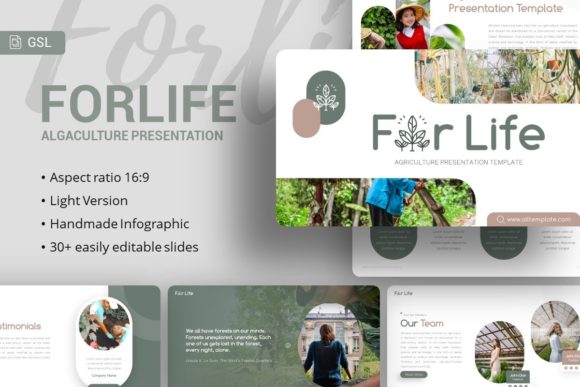
The template also emphasizes editable vector graphics and handcrafted infographics. Unlike static images that pixelate when resized or require external software to modify, these elements are native to the platform. Users can recolor charts, resize icons, and adjust diagram flows directly within the editing environment. The inclusion of drag-and-drop picture placeholders further streamlines the customization process, allowing creators to swap preview images with their own assets in seconds. It is important to note, however, that the high-quality photography seen in promotional previews is not included in the download. Users must source their own imagery, which is standard practice but requires additional preparation time.
Practical Applications Across Industries
The stated compatibility with diverse use cases warrants closer examination to determine where the Google Slides Template - Forlife performs best. Its strength is most evident in contexts requiring a blend of professionalism and visual engagement.
- Creative Agencies and Portfolios: The grid-based layouts and ample whitespace cater well to visual portfolios. Photographers and designers can showcase work without the template competing for attention. The minimalist aesthetic allows the portfolio pieces themselves to remain the focal point.
- Startups and Pitch Decks: Investors expect clarity and data literacy. The included infographic slides and structured content layouts help founders organize complex information into digestible formats. The ability to edit vectors means financial projections and market size diagrams can be tailored precisely without hiring a graphic designer.
- Corporate and Business Profiles: For established companies, consistency signals reliability. The master slide functionality ensures that departmental presentations maintain a unified corporate identity. The 35-slide library covers standard sections like team introductions, service overviews, timelines, and contact information.
- Agriculture and Sustainability: Given the "Forlife Agriculture" naming convention, the template naturally suits agribusiness, environmental consulting, and sustainability reporting. The organic yet structured design language bridges the gap between technical agricultural data and stakeholder communication.
While versatile, the template may be less suitable for highly academic or legal presentations that require dense text blocks and citation-heavy formatting. Its design philosophy prioritizes visual communication and brevity, aligning better with modern business standards than traditional document-style slides.
Workflow Efficiency and Customization Reality
Marketing materials often describe templates as "easy to customize," but experienced users know this term is relative. In practice, the Google Slides Template - Forlife delivers on this promise primarily because of its structural integrity. The use of native shapes and master slides reduces the friction typically associated with third-party templates. However, achieving a polished result still requires intentional effort.
Users should expect to spend time replacing placeholder content and sourcing appropriate imagery. Because the demo images are excluded, the initial setup phase involves gathering visual assets that match the template’s tone. Professionals who already have a brand kit or image library will transition smoothly. Those starting from scratch should budget extra time for asset creation or licensing. Additionally, while the infographics are editable, they are pre-designed structures. They accommodate standard data sets well but may require creative problem-solving if your data structure differs significantly from the provided examples.
The documentation file included with the download serves as a critical reference. Skipping this step is a common error that leads to frustration. Reviewing the guide first clarifies how master slides are organized and where specific editable elements reside, preventing unnecessary trial and error during active project work.
Assessing Quality and Long-Term Value
Beyond immediate aesthetics, the long-term value of a presentation template depends on its durability and scalability. The Google Slides Template - Forlife demonstrates solid construction through its pixel-perfect illustrations and resizable graphics. These elements maintain fidelity across different display resolutions and aspect ratios, reducing the risk of formatting errors when presenting on unfamiliar hardware.
From a cost-benefit perspective, this template offers significant leverage for freelancers and small business owners. Commissioning custom slide designs for each new client or project is financially unsustainable at smaller scales. A well-structured template amortizes design costs across dozens of presentations. Even for larger organizations, it serves as a reliable fallback or secondary brand option when primary templates are unavailable or inappropriate for specific audiences.
Reliability also stems from platform compatibility. As a Google Slides native format (with PowerPoint .PPTX support), it integrates seamlessly with cloud-based collaboration tools. Teams can co-edit, comment, and version-control presentations without worrying about font embedding issues or broken links that plague cross-platform workflows. This operational smoothness is often more valuable than flashy design features.
Determining Fit for Your Specific Needs
Deciding whether to adopt the Google Slides Template - Forlife requires honest assessment of your current capabilities and project requirements. This resource is ideal for users who understand basic presentation principles but lack advanced design skills. It bridges the gap between generic default themes and expensive custom work. If you frequently create pitch decks, company profiles, or visual portfolios and value consistency over novelty, this template aligns well with those objectives.
Conversely, users seeking highly specialized technical diagrams, complex animation sequences, or industry-specific regulatory compliance layouts may find the generalist nature of this template limiting. It provides excellent scaffolding but does not replace domain expertise or specialized data visualization tools. Additionally, those uncomfortable with self-directed customization should recognize that "editable" implies responsibility. The template empowers users to make changes, but it does not automate content strategy or visual judgment.
Ultimately, the Google Slides Template - Forlife represents a pragmatic choice for modern professionals. It acknowledges that presentations are working documents meant to communicate ideas efficiently, not just decorative artifacts. By combining aesthetic flexibility with functional master slides and editable infrastructure, it supports the iterative, collaborative nature of contemporary business communication. For those willing to invest the initial setup time, it offers a dependable foundation that can evolve alongside changing projects and audiences. Evaluating it against your specific workflow constraints and output expectations will confirm whether it deserves a place in your digital toolkit.