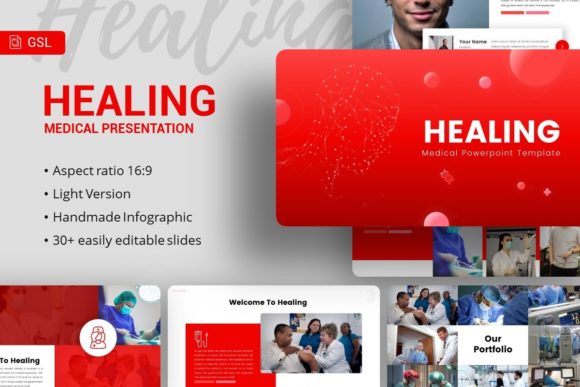
Google Slides Template - Healing: Streamlining Visual Communication for Professional Workflows
In the fast-paced environment of modern business and creative work, the time spent designing presentation decks often detracts from the actual strategy and content development. The Google Slides Template - Healing addresses this friction point by providing a pre-structured visual framework that accelerates the production process without sacrificing professional quality. While originally designed with medical and healthcare aesthetics in mind, the underlying architecture of this template supports a wide array of professional use cases, from corporate profiles and startup pitch decks to personal portfolios and creative agency showcases. Integrating this resource into your workflow is not merely about aesthetics; it is about establishing a reliable system for visual communication that scales with your projects.
Defining the Role of Healing in Project Planning
Before opening a slide deck, professionals must understand where a template fits within the broader project lifecycle. The Google Slides Template - Healing serves best as a foundational asset during the planning and structuring phases of a project. Rather than starting with a blank canvas, which often leads to scope creep and inconsistent formatting, this template provides 35 distinct slide layouts that act as modular building blocks. This modularity allows users to map out their narrative arc before finalizing specific content.
For entrepreneurs preparing a pitch deck or marketers outlining a quarterly review, the template functions as a storyboard. The included handcrafted infographics and master slides force a level of organizational discipline. You are not just placing text on a page; you are selecting a layout that dictates how information should be consumed. This shifts the focus from "how do I make this look good" to "does this layout support my data?" By utilizing the template early in the decision-making process, teams can identify gaps in their content strategy. If a specific master slide does not accommodate your data, it may indicate that the data needs refinement or that the narrative requires adjustment before significant design hours are invested.
Versatile Applications Across Business and Creative Sectors
Although the naming convention suggests a niche medical application, the structural versatility of the Google Slides Template - Healing makes it highly effective for diverse industries. The clean lines, ample whitespace, and professional typography translate seamlessly across different verticals. Understanding these cross-functional applications helps users maximize the return on investment for this digital asset.
- Creative Agencies and Portfolios: The picture placeholders and drag-drop functionality allow photographers and designers to showcase work within a consistent grid system. This ensures that the portfolio itself remains cohesive even when displaying disparate client projects.
- Corporate and Business Profiles: For established companies, consistency is key to brand trust. The master slide features ensure that headers, footers, and color schemes remain uniform across hundreds of slides, regardless of who creates them.
- Startups and Pitch Decks: Investors respond to clarity. The pixel-perfect illustrations and resizable graphics help startups visualize complex business models or market data without requiring a dedicated graphic designer for every iteration.
- Educators and Trainers: The infographic-heavy nature of the template supports instructional design. Complex concepts can be broken down into digestible visual chunks using the pre-designed diagram slides.
This adaptability means that a single license can serve multiple departments or freelance clients, making it a practical tool for productivity-minded users who manage varied output requirements.
Technical Integration and Workflow Compatibility
A critical factor in adopting any new template is compatibility with existing tools and workflows. The Google Slides Template - Healing is delivered as a PowerPoint .PPTX file, which bridges the gap between desktop software and cloud-based collaboration. This dual compatibility is essential for teams that operate in hybrid environments. Users can perform heavy editing and customization in Microsoft PowerPoint, leveraging its advanced formatting tools, and then upload the finalized version to Google Drive for real-time collaboration and presentation.
The inclusion of vector icons and editable graphics ensures that the assets remain crisp at any resolution. Unlike raster images that pixelate when resized, vector elements maintain integrity whether they are displayed on a mobile screen or projected onto a conference hall wall. Furthermore, the template relies on Master Slides rather than individual slide formatting. This technical distinction is vital for efficiency. When you update a logo or color palette in the Master Slide view, the change propagates instantly across all 35 slides. This global editing capability reduces the risk of version control errors and significantly speeds up the revision process during high-pressure deadlines.
Customization Strategies for Brand Consistency
To integrate the Google Slides Template - Healing effectively, users must move beyond simple text replacement and engage with the template’s customization architecture. The goal is to adapt the template to your brand identity, not to force your brand into the template’s default style. Start by auditing the master slides. Replace the default color scheme with your organization’s hex codes immediately. This prevents the accidental use of non-brand colors later in the process.
Utilize the documentation file included with the download. Many users skip this step, leading to frustration when trying to manipulate complex grouped objects or smart art. The documentation provides specific guidance on ungrouping elements, editing chart data links, and managing placeholder layers. Treat the template as a design system rather than a static document. Create a "Brand Kit" version of the Healing template where logos, fonts, and colors are pre-set. Save this as a separate master file. For every new project, duplicate this master file rather than the original download. This workflow preserves the integrity of the source asset and ensures that every new presentation starts with correct branding parameters already applied.
Optimizing Content Creation with Pre-Built Assets
The primary value proposition of this template lies in its library of handcrafted infographics and pixel-perfect illustrations. In a typical workflow, creating a custom SWOT analysis chart or a timeline graphic can take hours. With this template, these assets are ready for immediate deployment. However, efficient use requires understanding the hierarchy of these elements.
When working with the resizable graphics, always maintain aspect ratios to prevent distortion. Use the alignment tools native to your presentation software to snap elements to the grid. The template is designed with specific margins and safe zones; adhering to these guides ensures that your content looks professionally typeset. For users incorporating photography, the drag-and-drop picture placeholders automatically crop images to fit the designated shape. To get the best results, prepare your images to match the aspect ratio of the placeholder before importing. This prevents awkward cropping of focal points and maintains visual balance.
It is important to note that all images shown in the demo are for preview purposes only and are not included in the files. This exclusion is actually a benefit for workflow integration. It forces users to source or create their own relevant imagery, ensuring that the final presentation is authentic and legally compliant. Relying on stock photos embedded in templates can sometimes lead to licensing issues or generic-looking outputs. By treating the image slots as functional containers, you maintain creative control over the visual narrative.
Quality Control and Long-Term Asset Management
Adopting the Google Slides Template - Healing is also an exercise in quality control. Because the template is built on a standardized grid system, it acts as a guardrail against common design mistakes such as misalignment, inconsistent font sizes, and poor contrast. During the review phase of your project, check your slides against the master layout. If an element feels "off," it is likely because it has been manually moved outside the established guide structure. Reverting to the master layout alignment usually resolves visual tension instantly.
For long-term use, organize your digital assets logically. Keep the original .PPTX file, the documentation, and the vector icon pack in a dedicated folder within your cloud storage. Link this folder to your team’s knowledge base or internal wiki. When onboarding new team members or freelancers, provide access to this standardized template set. This reduces the learning curve and ensures that external collaborators deliver work that matches your internal standards. Over time, you may find yourself adding custom slides to the master deck based on recurring needs. Document these additions so the template evolves alongside your business processes.
Enhancing Productivity Through Standardization
Ultimately, the integration of the Google Slides Template - Healing into your routine is a productivity strategy. By standardizing the visual layer of your communication, you free up cognitive resources for higher-value tasks like storytelling, data analysis, and audience engagement. The 35-slide variety covers the vast majority of business scenarios, reducing the need to search for external assets or hire designers for routine updates.
Whether you are a freelancer managing multiple client brands or a corporate executive streamlining internal reporting, this template offers a structured path to better presentations. It transforms the chaotic process of slide creation into a manageable, repeatable workflow. By respecting the technical foundations of the template—master slides, vector assets, and modular layouts—you ensure that your presentations are not only visually appealing but also operationally efficient. The result is a more agile communication process that supports faster decision-making and clearer information delivery across all your professional endeavors.