Strategic Application of the Google Slides Template - Mosucity for Professional Communication
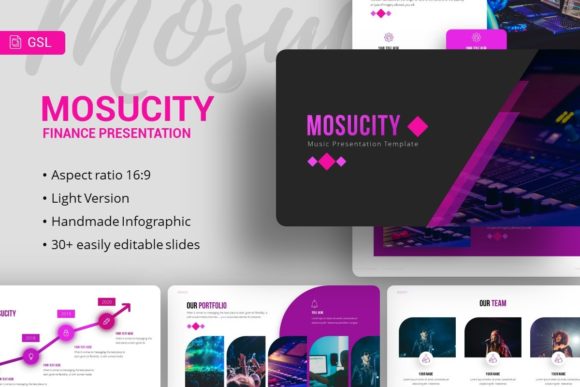
Selecting a presentation framework is rarely just an aesthetic decision; it is a strategic choice that dictates how information is processed, retained, and acted upon. The Google Slides Template - Mosucity represents a specific category of visual communication tools designed to bridge the gap between creative expression and corporate structure. For professionals ranging from startup founders to creative directors, this template offers more than pre-designed layouts; it provides a scaffold for narrative consistency. When introducing the Mosucity Music Google Slides Template into your workflow, the primary value proposition lies in its versatility across diverse business functions, including pitch decks, company profiles, and personal portfolios. However, leveraging this asset effectively requires moving beyond simple drag-and-drop mechanics to understand how its 35 unique slides can be mapped to specific organizational goals and audience expectations.
Aligning Visual Structure with Business Objectives
The core utility of the Google Slides Template - Mosucity emerges when users treat the slide deck as a modular communication system rather than a linear storyboard. With 35 distinct slides based on master layouts, the template supports non-linear planning. This is critical for entrepreneurs and marketers who must often pivot their messaging based on stakeholder feedback without redesigning entire presentations. The handcrafted infographics included in the package serve as cognitive anchors, transforming abstract data into digestible visual concepts. For a creative agency or photography portfolio, these elements establish immediate credibility. For a corporate entity or startup pitch deck, they demonstrate operational maturity.
Strategic use involves auditing your content needs before opening the file. If your goal is investor acquisition, prioritize the data-heavy infographic slides and team profile layouts to build trust. If the objective is brand awareness or a personal portfolio showcase, lean into the image-dominant slides that utilize the pixel-perfect illustrations. The template’s resizable and editable graphics ensure that whether you are presenting on a mobile device during a quick sync or projecting onto a conference hall screen, the visual integrity remains intact. This adaptability reduces the friction between content creation and final delivery, allowing teams to focus on message refinement rather than formatting troubleshooting.
Operational Efficiency and Brand Consistency
One of the most significant risks in professional presentation design is brand dilution caused by inconsistent formatting across different team members or projects. The Google Slides Template - Mosucity mitigates this through its Master Slide architecture. By embedding brand colors, typography, and logo placements at the master level, organizations can ensure that every output—from internal quarterly reviews to external client pitches—adheres to established identity guidelines. This is particularly valuable for small business owners and freelancers who lack dedicated design teams but must maintain a polished, professional appearance to compete with larger entities.
The inclusion of vector icons and picture placeholders further streamlines operations. Instead of sourcing disparate assets that may clash stylistically, users have access to a cohesive library of visual elements. This cohesion is not merely decorative; it signals attention to detail and reliability to clients and partners. When updating a company profile or refreshing a portfolio, the ability to simply swap images via drag-and-drop functionality while retaining layout proportions saves hours of manual adjustment. Over time, this efficiency compounds, allowing professionals to allocate more resources toward strategy development and client relationship management rather than slide production.
Navigating Use Cases: From Pitch Decks to Personal Branding
The breadth of applications for the Google Slides Template - Mosucity requires users to be intentional about customization. A common pitfall is using the same slide selection for vastly different audiences. To maximize impact, consider the following strategic distinctions:
- Startup Pitch Decks: Focus on clarity and narrative flow. Utilize the problem/solution infographic slides to articulate value propositions quickly. Avoid over-decorating; let the data and the business model take precedence. The pixel-perfect illustrations should support the story, not distract from the financials or market analysis.
- Creative Agency & Portfolios: Prioritize visual immersion. Use the full-bleed image placeholders to showcase work samples. In this context, the template acts as a gallery frame. Ensure that text overlays are minimal and legible against varied background imagery. The goal here is to demonstrate aesthetic capability and technical proficiency simultaneously.
- Corporate & Business Profiles: Emphasize structure and hierarchy. Use the team introduction and timeline slides to convey stability and experience. The handcrafted infographics are ideal for breaking down complex service offerings or organizational structures into understandable segments. Consistency in icon usage helps guide the viewer through dense informational content.
- Educational & Training Materials: Leverage the variety of layout options to maintain engagement. Alternate between text-heavy explanation slides and visual summary slides to prevent cognitive fatigue. The resizable graphics allow for the integration of diagrams and charts that clarify learning objectives without overwhelming the student.
Understanding these nuances prevents the generic application of the template. Each use case demands a different configuration of the available 35 slides to achieve the desired outcome.
Mitigating Risks and Ensuring Intentional Design
While the Google Slides Template - Mosucity is a powerful asset, reliance on any pre-made tool carries inherent risks if approached without critical thinking. The most prevalent issue is the "template trap," where presentations begin to look identical because users fail to customize beyond surface-level text replacement. To avoid this, treat the template as a starting point, not a finish line. Modify color palettes to match specific campaign themes or seasonal branding. Rearrange slide orders to better fit your unique narrative arc. Combine elements from different master slides to create hybrid layouts that serve specific communicative needs not covered by the default set.
Another consideration is the distinction between preview assets and functional files. As noted in the documentation, demo images are for preview purposes only and are not included in the downloadable files. Strategic planners must account for this by having high-quality, licensed, or original photography ready before beginning the design process. Using low-resolution placeholders or watermarked stock photos in a final presentation undermines the professional polish the template is designed to provide. Furthermore, ensure that all vector icons and illustrations are edited to align with your brand’s visual language. Uniformity in stroke weight, color saturation, and style is essential for maintaining perceived quality.
Long-Term Value and Scalability
Investing time in mastering the Google Slides Template - Mosucity yields compounding returns. As teams become familiar with the master slide structure and graphic libraries, production velocity increases. New hires can be onboarded faster by providing them with a standardized template that embodies company communication standards. Client deliverables become more predictable in quality and turnaround time. For freelancers and consultants, owning a versatile, high-quality template reduces the overhead associated with custom design work for every new project, improving profit margins and allowing for more competitive pricing or higher capacity.
Moreover, the template supports iterative improvement. Because it is built on editable master slides, updates to brand guidelines or design trends can be implemented globally across future presentations with minimal effort. This scalability is crucial for growing businesses that need their communication assets to evolve alongside their operations. The documentation file included with the download serves as a vital reference for maximizing these long-term benefits, ensuring that users understand not just how to edit a slide, but how to manage the underlying system that makes the template effective.
Making the Decision to Adopt Mosucity
Deciding whether the Google Slides Template - Mosucity is the right tool for your current needs involves assessing your resource constraints and communication goals. If your team lacks dedicated design expertise but requires professional-grade outputs for multiple scenarios, this template offers a high-value solution. Its balance of creative flair and corporate utility makes it suitable for hybrid organizations that operate at the intersection of art and commerce. However, if your requirements are highly specialized or regulated, verify that the template’s flexibility accommodates necessary compliance or industry-specific formatting standards before adoption.
Ultimately, the success of this presentation template depends on the user’s strategic intent. It is a vessel for ideas, not a substitute for them. By approaching the Google Slides Template - Mosucity with a clear understanding of your audience, objectives, and brand identity, you transform a collection of 35 slides into a dynamic engine for persuasion, education, and connection. The tools are provided; the strategy must be yours. Thoughtful implementation ensures that every presentation not only looks exceptional but also drives measurable progress toward your broader professional and organizational ambitions.